
Soft washing vs pressure washing is not really a choice between two products. It is a question of which surface you are standing in front of. One method cleans with force, the other cleans with a chemical and time, and pointing the wrong one at your home is how people end up with stripped render or paint peeling off the weatherboards. Most properties we quote need both, in the right order, on the same visit.
What is pressure washing?
A pressure washer is a pump. It takes mains water, pushes it through a narrow nozzle, and the water arrives at the surface fast enough to knock dirt off mechanically. That is the whole idea. High psi, a small opening, and the force does the work. Machines get sold on their psi and gpm figures, and neither number tells you whether that machine belongs anywhere near a wall. A bigger number may only mean you can do damage faster.
You will see the same job advertised as power washing. In practice the two names get used for the same thing, and neither name tells you anything about how the operator will treat your walls.
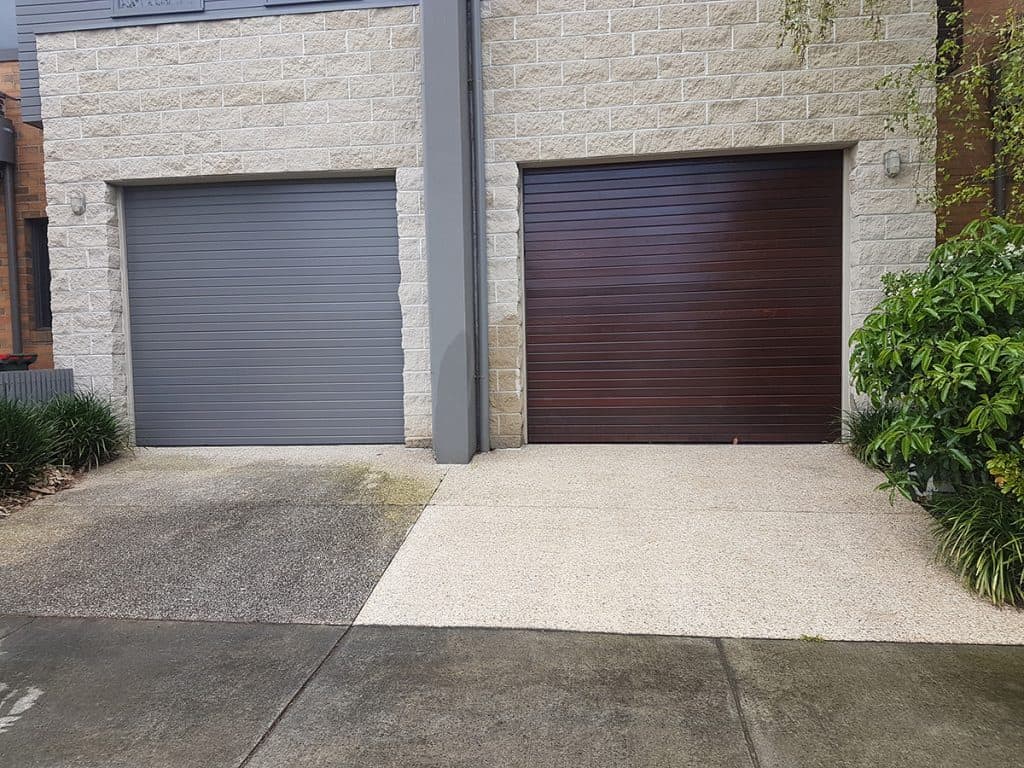
For flat concrete we use a surface cleaner attachment rather than a bare lance: a shrouded head with spinning jets underneath that covers an even width as it is walked along. That matters more than people think. A bare wand held by hand leaves tiger stripes on concrete, dark and light bands where the passes overlapped, and once they are in the slab the only fix is doing the whole thing again properly. A professional setup also matches the pressure to the surface. Exposed aggregate, old pavers and a two year old plain concrete driveway do not all take the same setting.
Where high pressure earns its keep is oil under the car, moss in the mortar joints of paving, that slippery green film on a shaded path, and the general grime that builds on hard, unpainted, non porous surfaces. Nothing else touches a stained driveway as quickly.
What is soft washing?
Soft washing runs at a fraction of that psi, low enough that you could hold your hand in front of the nozzle. The cleaning is done by a chemical solution, not by force. It goes on the wall, it sits, it kills the mould and lichen and the black algae growing in the surface, and then the wall is rinsed down.
The dwell time is the part that gets skipped by people in a hurry, and it is the part that makes the results last. Growth on a wall may look like plain dirt, but it has roots in the substrate. Blast it with water and you remove the visible half, leaving the rest to come back by spring. Kill it and rinse it, and you are starting from a dead surface.
Low pressure also means the water is not being driven anywhere it should not go. That is not a small thing on a house with timber cladding, where every board laps over the one below it and every lap is a gap.
Water: where it goes matters as much as how hard it hits
Both methods need a tap and both put a lot of water against the side of a building. The difference is direction and velocity. Rinse water runs down a wall and off. Water fired at high psi goes sideways and upward into laps, under tiles, past window seals and behind cladding, and it does not come back out. Damage from that is slow and invisible for weeks, then it is a stain on a ceiling or a soft patch of timber.
Runoff is the other water question, and it is the reason garden beds get soaked with plain water before any solution goes on. Wet soil dilutes whatever reaches it. Downpipes, drains and the neighbour’s paving all get a thought before the job starts rather than after.
Soft washing vs pressure washing: which surfaces get which
The short version: hard, unpainted and non porous takes pressure. Painted, porous or delicate takes a soft wash. Getting the right method on the right surface is most of the job.
High pressure suits driveways, paths, crossovers, exposed aggregate, pavers and brick paving, concrete steps, retaining walls, bin and wheelie bin areas, warehouse floors and loading docks.
Soft washing is for painted weatherboard and timber cladding, render and bagged brick, face brick walls, Colorbond and metal cladding, the fibre cement sheeting and siding on newer builds, eaves and fascias, roofs of any material, painted fences, decking, pergolas and shade sails.
Roofs deserve their own line. A tiled roof is hundreds of overlapping tiles designed to shed water downhill, so a high psi jet pushes water uphill into the laps and strips the surface coating off the tiles at the same time. Roofs are soft washed, and they are the most delicate thing on the property despite being the toughest looking. Solar panels are never high pressure washed either.
Most homes need both
A typical job at a Melbourne home goes something like this. The gutters get cleared first, because clearing them sends sludge down the fascia. The roof, walls, eaves and fences get soft washed. Then the driveway, paths and any paving get the pressure treatment, because a surface cleaner throws grey spray a couple of metres and you do not want that on walls you just finished. Windows last, since wall washing puts solution and grit on the glass.
That order is the reason booking the lot in one visit beats booking three trades across three weekends.
Questions we get asked
Is soft washing better than pressure washing?
Neither is better. They do different jobs. Asking which is best is like asking whether a broom beats a mop. Use high pressure on the hard surfaces and a soft wash on everything painted or porous, and you get the best of both. Use one where the other belongs and you get damage.
Can I use my pressure washer as a soft wash system?
Not properly. A domestic pressure washer with a wide nozzle and the trigger feathered is still a pressure washer with the pump running, and the moment your wrist tires you are back to high psi against render. A professional soft wash system applies solution at low pressure and holds it there consistently, which is a different setup, not a different technique on the same equipment. Detergent tanks on consumer machines are built for car washing, not for treating a wall of lichen.
If you’re going to do it yourself, the safer advice is to keep the machine for the driveway and leave the delicate surfaces to a professional with the right gear. Damage to render or a paint film is not something you notice while you are doing it. Ladder work and roof work on top of that is where most weekend jobs go wrong.
What does it cost to soft wash a home?
It depends on the size of the home, how many storeys, how much growth is on it, what the surfaces are, and how easy the access is down the sides. A single storey brick veneer with a bit of black staining is a different job to a double storey rendered home that has not been washed in a decade. We quote free, before any work starts, and we can often do it from a few photos of the worst side. Send those and you will get a real number rather than a range.
Is a soft wash worth it?
If your walls have growth on them, yes, because the growth is not sitting there politely. Mould and lichen hold moisture against paint and render, and constant damp is what breaks a coating down. A wash also buys you time before a repaint, which is the comparison worth making. And if you are selling, the results show up in every photo the agent takes.
Work out which surfaces at your place are hard and which are painted or porous, then get the whole exterior quoted at once. Our house washing Melbourne page covers the soft wash side, pressure washing covers the concrete and paving, and if you would rather just ask someone, call us on 03 8682 8767 seven days a week.